Dtocs: A perfect blend of elegance, convenience and sustainability
- KLS

- Mar 5
- 9 min read
Updated: Apr 14
For the 232nd feature of our "Together Talks" campaign, we collaborated with Dtocs and Founder, Pallavi Pande. They pride themselves in offering disposable palm leaf tableware that is 100% natural, elegant, compostable & sturdy. In short, a hallmark of greener lifestyle! Perfect for events, weddings, camping, restaurants, resorts, and other hospitality services. DTOCS LLC is a company based out of Portland, Oregon, United States.

"Together Talks" feature 232: Dtocs presented by KLS - Your Trusted Shipping Solutions In The USA
What separates you from your competition? What have been the biggest challenges? Goals for upcoming year + Next phase of the company?
What were your concerns to transition to starting your own business? What have you learned since becoming an entrepreneur? What aspect of entrepreneurship do you appreciate the most? Share a decision that you made that was detrimental? What is your why?
Story of how it was created?
Dtocs was founded in 2019, born out of a very personal frustration. I am a mom who loves to host. I love to party. I love bringing people together around a table. But what I absolutely hated was the single-use tableware we relied on for those gatherings.
I was constantly coming back to the same three options: cheap paper plates that get soggy, toxic plastics that don’t feel good to eat from, or traditional chinaware that meant hours of dishwashing afterward. I wanted a better, more sustainable alternative—but I simply couldn’t find one in the market.
That’s where Dtocs was born.
Dtocs is a cool, five-letter brand name that echoes the idea of a cleansing journey—cleansing ourselves of single-use disposables. I have notoriously become the mompreneur who “rescues” palm leaves and bamboo fiber and converts them into tableware: plates, bowls, spoons, straws, cutlery, to-go containers, clamshells, and even charcuterie boards.
For the past six years, I’ve been building this with women workers in India. We manufacture our palm leaf tableware there using the areca palm, a variety of palm tree found in regions such as Cambodia, Brazil, Indonesia, Thailand, Vietnam, and India. I was intentional about starting in the country where I was born. I wanted to make a difference in the livelihoods of women there and then expand our social impact beyond India.
Over time, we also introduced bamboo fiber products, which are manufactured in China. Today, we serve direct-to-consumer customers as well as restaurants, food service businesses, caterers, chefs, event planners, wedding planners, vineyards, boutique hotels, and resorts. And of course, we serve hosts like me—people who love entertaining but don’t want to be the “chief dishwashing officer” after every gathering.
At the end of the day, I didn’t want convenience to equal guilt. I didn’t want to use something for a couple of hours that would sit in a landfill for 500 or 1,000 years. Personally, I also wanted to role model responsible choices for my children, starting in my own home.
Here’s a question I often ask: Do you know how much single-use waste we create annually at home through parties and gatherings?
The answer is staggering—960,000 metric tons of single-use waste every year. That’s equivalent to the weight of 150,000 elephants. And that’s just annually, in the places where we live. Now imagine the cumulative impact on the planet.
We all have a footprint. And if each of us takes responsibility for our own footprint, that ripples outward into a collective initiative for change.

What separates you from your competition?
When I started in 2019, there were very few companies offering palm leaf and other sustainable tableware alternatives. After COVID, I saw many competitors enter the space. And honestly, that’s a good thing—it shows there is demand and growing consumer awareness.
So how do we position ourselves as different?
First, I am deeply connected to the product culturally. I grew up in India eating on banana leaves as a child. Even today, when I go back, we continue that tradition. This isn’t just a trend for me—it’s a lived experience and something I’m genuinely passionate about.
Second, I bring 10 years of experience in supply chain, logistics, warehousing, and inventory management. I understood manufacturing, distribution, and scaling. That’s why I had the confidence to start from scratch—literally from leaves on the ground, working with women in India—and grow into Canadian markets, European markets, and diversify into bamboo fiber.
Palm leaves are incredible, but they have limitations. They cannot be bent into lids. They cannot be formed into forks or knives. There’s a limit to what you can create with them. That gap led us to expand into bamboo fiber, which allows us to manufacture lids, to-go containers, and other products that leaves simply cannot support.
Many competitors focus primarily on bagasse (sugarcane) products. While those are compostable, they are not 100% compostable in the same way areca palm products are. Our areca palm products are 100% compostable within 90 days.
We are certified by the Compost Manufacturing Alliance, which validates our compostability claims. This certification allows us to partner with composters nationwide. For example, at large outdoor events—beer festivals, music festivals, and other gatherings requiring industrial composting—we collaborate with composting partners to ensure our products are properly processed and do not end up in landfills.
That’s a major differentiator.
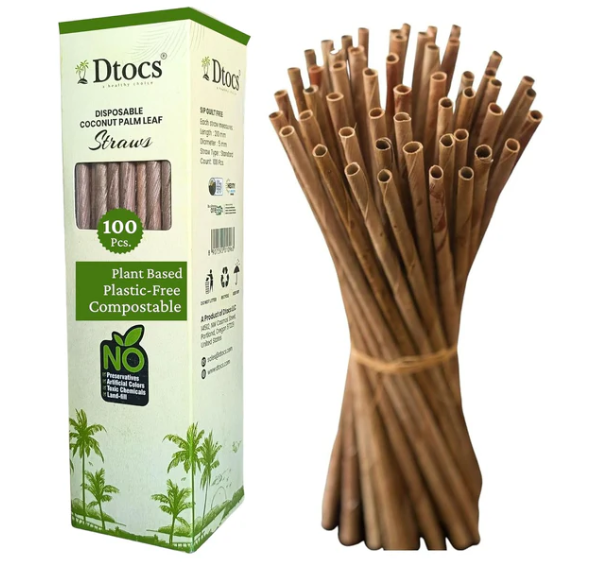
We also offer patented straws that last up to six hours in liquid—unlike typical paper or plastic alternatives that disintegrate quickly. These straws were tested in a national retailer’s program and performed so well that we were asked to develop retail packaging. That opened doors for us in the $100 billion beverage industry.
On packaging, we listened closely to our customers. They didn’t just want sustainable products—they wanted zero-waste packaging. So we upgraded four SKUs to 100% compostable wraps.
That process was not easy. Compostable wraps are less sturdy than recycled or plastic wraps. They’re not crystal clear. Some even resemble compostable pet waste bags—which, let’s be honest, is not the aesthetic you want for your dinner plates. They can break down with heat or when used on irregular shapes.
Despite the constraints, after four years in business, we successfully implemented compostable packaging on selected products.
On the social impact side, we are the only brand in our space with People + Planet First verification—a foundational certification within the B Corp ecosystem. That validation confirms both our environmental and community impact.
To date:
We have eliminated more than 20 million single-use products from events.
We have donated sewing machines to 10 women in India to support their livelihoods.
We have funded 25 education scholarships for children in India.
We make annual donation pledges in Oregon to a nonprofit called Greater Than Portland.
Everything we claim is validated. That gives consumers confidence that when they support us, they are aligning with real, measurable impact.
What have been the biggest challenges?
Funding has absolutely been one of the biggest challenges. Funding fuels growth. Without it, you cannot invest in warehousing, logistics, packaging, marketing, or inventory.
We frequently face low cash flow cycles because our selling cycles are long. Manufacturing in India alone takes time, and shipping containers to the U.S., Canada, or other countries takes approximately 45 days. From there, products go to warehouses, and only then does sales begin.
Add in payment terms with suppliers and receivables from platforms like Amazon, Wayfair, Etsy, and Walmart, and you can see how cash flow becomes tight.
To navigate this, we pursued non-dilutive funding. Over the past six years, we have secured more than $130,000 in grants through written applications and live pitch competitions. Those funds have primarily supported inventory purchases—because inventory is the engine of our business.
Once we have inventory, we know we can sell through.
Goals for upcoming year + Next phase of the company?
2026 is an exciting year as we prepare for our European launch. Right now, I’m focused on compliance, registrations, capital planning, and supply chain diversification to serve European markets.
This expansion requires strategic planning: marketing, trade shows, in-person relationship building in food service and hospitality, and wholesale partnerships. It’s exciting—and nerve-wracking—because it requires significant upfront investment.
We also recently secured our import-export license, which allows us to diversify into additional product categories and serve new markets globally. Over the next 12 months, we will experiment with expanding vertically.
In addition to Dtocs, we launched a second company: Dtocs Consulting. After building a profitable, positive cash-flow, seven-figure brand, other founders began approaching me for help with Amazon growth.
Because of our deep hands-on experience with Amazon, Dtocs Consulting was formed to help founders sell, scale, and grow on Amazon.
What were your concerns to transition to starting your own business?
Before Dtocs, I launched two businesses.
The first was a jewelry brand called Iman’s (Internet Diamonds). While jewelry seemed like an easy category, returns became complicated. We hadn’t fully thought through the return process for high-value items. That business eventually closed—but I gained valuable lessons in distribution and operations.
The second was an intimacy subscription box created after the birth of my first child. It was designed to help couples reconnect during postpartum transitions. I loved curating the boxes and understood wholesale and distribution. However, compliance in the adult product space became a major hurdle, and we had to shut down.
By the time I started Dtocs, I had learned from those experiences.
The turning point came during one of my parties. I remember buying bulk paper plates from Costco—packs of 200 that lasted only two months. I kept hearing the same complaints: paper plates get soggy, plastic leaches into food, chinaware requires washing and can break around kids.
I began asking people directly what frustrated them most. Their answers became my market research.
Combined with my childhood memories of eating on leaves and my decade of supply chain experience, I finally felt confident launching Dtocs.
What have you learned since becoming an entrepreneur?
Do your market analysis. Talk to your customers.
The more conversations I had, the clearer and more confident I became. A flashy website and marketing plan mean nothing if you don’t deeply understand the problem you’re solving.
The third time around, clarity came because I asked better questions.
What aspect of entrepreneurship do you appreciate the most?
Travel.
I deeply appreciate the ability to travel—with family and for business. We’ve traveled to 25 countries while blending work and leisure. I’ve met buyers, distributors, vineyards, event planners, and hospitality partners across the globe.
At the same time, we’ve enjoyed beaches, camping trips, and meals using our own tableware instead of paper plates.
Travel has been one of the most cherished parts of this journey.
Share a decision that you made that was detrimental?
Early on, everyone said, “Google Ads is the way.”
So I hired a local Google Ads agency in Oregon through a personal recommendation. Over six months, I spent $20,000—far beyond our comfort zone.
We generated one conversion.
When I questioned the results, I was told it takes more time. But we didn’t have the luxury of unlimited ad spend.
A mentor advised me: Go back to your data.
When I reviewed it, 90% of our customers were purchasing on Amazon. That was our strongest channel—not Google.
It was a painful but powerful lesson: follow your data, not trends.

What is your why?
Many people talk about legacy as something you leave behind. I see legacy as something you practice daily.
Sustainability is the same way. It’s not about waking up one day and deciding to be sustainable. It’s about mindful, daily decisions.
It’s easy to say, “It’s just one straw. It’s just one plate.” But when millions of people think that way, the impact is massive.
I want sustainability and mindfulness to be part of my everyday life—and my children’s.
Do you have a moment that brings you the most joy?
One of my proudest moments was being named a CO100 Judge for 2025.
As an immigrant woman of color running a seven-figure brand, I often had to prove myself repeatedly just to get a seat at the table.
Becoming a judge felt like a moment to pay it forward—to recognize and elevate other founders and give them representation.
Piece of Advice
Do it. You will never know until you try.
But don’t go big and reckless. Run small experiments. Iterate quickly. Fail fast and improve.
Look at your data consistently. If not daily, then biweekly, monthly, or quarterly—but not once a year.
If you ignore your data for 365 days, you’ve lost 365 opportunities to iterate, pivot, escalate, or grow 10x.
Data helps you decide when to cut back, stop, change, or accelerate. Build the habit.
Promo Code
Sustainability doesn’t require massive change—just small, intentional decisions.
For your audience, I’d love to offer 20% off with the code DTOCS20 at Dtocs. Products are delivered straight to your door—convenient, guilt-free, and ready for your next gathering.
I also welcome feedback. Connect with us. Tell us what you love and what we can improve. And feel free to connect with me on LinkedIn—I value genuine conversations.
Community Callout
I want to give a strong shoutout to Amazon.
We have grown and scaled globally by leveraging Amazon’s infrastructure. It’s a system they have built and refined—a proven playbook that truly works if you understand how to use it. We’ve taken advantage of everything Amazon offers: advertising tools, AI creator tools, enhanced video and image capabilities, warehousing, FBA, storage, and distribution.
We didn’t just list products and hope for the best—we immersed ourselves in the ecosystem and learned how to use every lever available. That foundation allowed us to build Dtocs into a globally recognized brand.
Today, my relationship with Amazon has evolved beyond being a seller. Through our second company, Dtocs Consulting, we operate as a boutique, full-service Amazon firm. We now help other founders sell, scale, and grow on Amazon using the same strategies and infrastructure that helped us succeed.
Because of this, I’ve developed strong internal relationships with Amazon’s team—not just as a brand owner, but as a growth partner supporting other entrepreneurs. That connection has been incredibly meaningful, and it’s something I feel proud of.
Amazon has played a foundational role in our journey, and it’s absolutely an organization I want to highlight and acknowledge.
In Closing
KLS wants to thank Dtocs and Founder, Pallavi Pande, for today's "Together Talks" feature. Follow along for their journey with their social handles below!


Comments