hiya: Vitamins Made Just for Kids

For the 243rd feature of our "Together Talks" campaign, we collaborated with hiya and VP of Operations, Casey Koroly. Traditional children’s vitamins often cause more problems than they solve. So we made a better one.

"Together Talks" feature 243: hiya presented by KLS - Your Trusted Shipping Solutions In The USA
What separates you from your competition? What have been the biggest challenges? Goals for upcoming year + Next phase of the company?
How did your previous experiences help you with this role? Share a decision that you made that was detrimental? What is your why?
Story of how it was created?
Hiya was created at the onset of COVID by two dads who were trying to find a better, sugar-free vitamin option for their kids.
After visiting pediatricians, they kept being recommended gummy vitamins—but many of those products were loaded with sugar. They wanted to create something better for their children.
Both founders were experienced entrepreneurs with strong backgrounds in building and scaling brands, so they decided to go all in on creating Hiya.
Fast forward six years, and the brand has since been acquired by a parent company that now owns a majority stake. They’ve proven to be incredible operational and manufacturing partners, and the relationship has been very positive.
You often hear stories of acquisitions where the brand loses its identity or gets diluted. In our case, it’s been the complete opposite. We’ve been able to leverage their manufacturing capabilities in ways we never could have on our own, and the team synergy has been strong.
At this point, we’re about a year into the partnership, and I’m genuinely very happy with how it’s evolved.
What separates you from your competition?
Our product is a chewable tablet—something very familiar in format. I often compare it to the classic Flintstones vitamins many of us grew up with in the ’90s.
We’re essentially offering a modern version of that experience—without the sugar.
A lot of parents today want to give their kids something similar to what they had growing up, but with better ingredients and a more thoughtful formulation. That’s where we fit in.
But what really sets Hiya apart is something I didn’t fully appreciate until I joined: the experience.
It’s not just about taking a vitamin—it’s about making kids excited to take it.
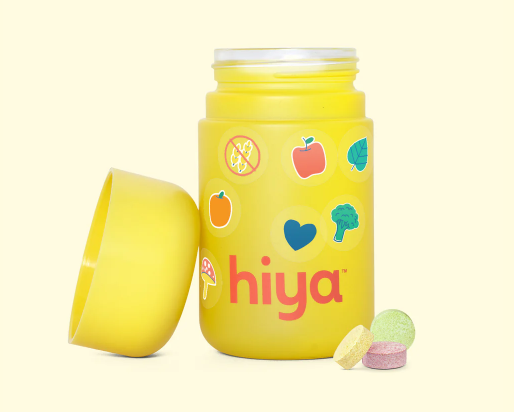
We design collectible jars—like themed collaborations, for example—and each one comes with sticker packs that kids can use to decorate and personalize their jar. It creates an interactive experience around something that would otherwise feel routine.
It’s not a toy, but it has that element of engagement. Kids feel involved, and that makes them more likely to consistently take their vitamins.
That was a really smart psychological insight from the founders—turning a daily habit into something fun and interactive.
As we grow, we’re continuing to explore how to extend that experience into new products—finding ways to deliver nutrition while maintaining that same level of engagement.
What have been the biggest challenges?
The company is still relatively young, and it experienced very rapid growth early on.
When you’re scaling that quickly, a lot of decisions are made to solve immediate problems—without always building for long-term infrastructure.
When I came in, the leadership team had an ambitious roadmap—about 20 major initiatives they wanted to execute within a year.
Individually, I had experience with all of those initiatives—but over the course of a decade, not all at once.
At the same time, I was stepping into a leadership role where I needed to guide a team to execute on all of it, which was new for me. I had been very hands-on in the past, but not necessarily leading teams at this scale.
It required trust—from both sides.
What’s been incredible is what we’ve accomplished as a team. In one year, we’ve executed a Canada rollout, a UK rollout, a Target launch, expanded on Amazon, built out TikTok, and implemented major backend systems like EDI integrations and NetSuite.
And we’ve done all of this with a small, highly effective team.
Our operations team is about five people, and the broader company is around 30 to 35 employees. Everyone contributes, and the culture is incredibly low-ego despite the level of achievement.
It’s honestly one of the most collaborative and positive environments I’ve experienced. There’s a shared sense of purpose—many team members are parents themselves, and there’s genuine care behind what we’re building.
That culture is a huge part of why people stay.
Goals for upcoming year + Next phase of the company?
This year is focused heavily on experimentation and expansion.
International markets are a key area of focus, but they require different formulations to meet regional standards. We’re taking a test-and-learn approach to understand whether there’s long-term opportunity in those markets.
Retail in the U.S. is also a major priority. We’re currently in conversations with additional major retailers, and we have some exciting developments coming with Target later this year.
Broadly, we’re working to expand beyond our D2C foundation. While D2C remains important, retail helps legitimize the brand and unlock new growth channels.
We believe that this next phase—diversifying distribution—is where we’ll see the most significant growth.
What were your concerns to joining this company?
Before joining full-time, I spent about three years consulting, taking on a variety of projects.
Consulting can be isolating—it’s a constant cycle of finding work, delivering work, and managing uncertainty. When I moved back to California, the financial pressure increased, and I started thinking more seriously about stability.
At the same time, I wanted to lead a team and build something more substantial.
In operations, you often end up being the “problem solver”—fixing issues across the business without always getting recognition for it. I wanted the opportunity to step back, build systems, and create something more strategic.
Consulting gave me confidence in my skill set—I learned a lot and validated what I knew—but I was ready for something bigger.
I briefly joined another organization, but it became clear that our visions didn’t fully align.
When the opportunity with Hiya came up, it happened very organically. I had a conversation with one of the founders, and there was an immediate alignment in energy and vision.
They had just been acquired, had strong financial backing, and were ready to scale. I was looking for the opportunity to build and lead.
It was the right fit at the right time.
How did your previous experiences help you with this role?
There’s a moment in your career where you transition from being a doer to being a leader.
I knew I was highly capable in execution—but I hadn’t yet fully stepped into leadership.
One of the biggest realizations for me is that leadership is often harder than execution. The soft skills—motivating people, influencing decisions, developing your team—are more complex than simply doing the work yourself.
What’s been key is learning when to step in and when to step back.
I can still operate as a doer when needed, but I’m also intentional about giving ownership to my team—allowing them to grow, while staying available for support and guidance.
Understanding each team member—what motivates them, where they’re strong, where they need support—has been critical.
That balance has been a major driver of our success.

Share a decision that you made that was detrimental?
One of the more challenging moments came during our Target retail launch.
There’s an immense amount of behind-the-scenes complexity—EDI integrations, warehouse coordination, ASN transmissions, invoicing—and it often sits at the intersection of sales, operations, and IT.
It’s a space where not many people have full visibility, which can create stress.
During that period, our culture was tested more than at any other time. The pressure was high, and there were moments where communication broke down and tensions rose.
For me, the lesson was about leadership presence.
I initially took a more hands-off approach, trusting my team to manage things. But I realized that in high-pressure situations, it’s important to step in earlier—ask questions, understand the challenges, and provide support before issues escalate.
If I don’t have visibility into what’s happening, that’s a problem. And if I don’t understand it, I can’t expect my team to fully navigate it either.
That experience reinforced the importance of being both supportive and actively engaged as a leader.
What is your why?
This is a meaningful question—especially working in children’s nutrition.
The founders’ “why” is clear: provide kids with better nutrition, without added sugar, in a way that actually works.
For me, it’s personal.
I’ve been living with Type 1 diabetes and celiac disease for over 20 years. Nutrition has been a central part of my life since childhood—reading labels, understanding ingredients, and thinking critically about what I consume.
When I think about kids today, I see an opportunity to give them a better foundation.
Whether it’s addressing nutrient gaps—like iron or gut health—or simply helping them build healthier habits early, it all contributes to long-term well-being.
I often think about how different things might have been if I had access to better nutrition as a child. There are no guarantees, but giving kids the best possible foundation matters.
Food today is complex—there’s so much more to consider beyond just what’s listed on the label.
Being part of a company that’s trying to improve that foundation, even in a small way, is incredibly important to me.
Do you have a favorite testimonial or story from the brand?
Honestly, it’s the everyday moments that stand out the most.
When I hear from friends that their kids—who refuse to eat vegetables—are actually excited about something like our chocolate greens, that’s meaningful.
Even if it’s just one small improvement, it matters.
Knowing that kids are getting some form of nutrition when they otherwise wouldn’t—that aligns directly with why we do this.
Do you have a moment that brings you the most joy?
For me, it’s the feedback from my team.
I’m incredibly proud of the culture we’ve built, and when team members tell me they’re happy, that they feel supported, that they’re choosing to stay—that means everything.
I’m very protective of that environment.
Hearing that we’re doing things the right way, that people feel valued and heard—that’s where I take the most pride.
Piece of Advice
One of the biggest lessons in my career has been that mastering soft skills is often harder—and more important—than mastering hard skills.
Learning how to influence people, align stakeholders, and guide decision-making is critical—especially as you step into leadership roles.
With more millennials moving into leadership positions, there’s often a desire to move quickly and make decisions independently.
But real impact comes from understanding how to bring people along—especially across different generations and perspectives.
That’s been one of the most challenging and rewarding parts of my journey.
Community Callout
Crete Academy - They’re one of our partners, and we actively support their work.
Crete Academy focuses on supporting students in underserved areas of Los Angeles, including neighborhoods like Crenshaw, providing educational opportunities and creative outlets.
It’s an organization we deeply believe in, and we’re proud to support their mission.
In Closing
KLS wants to thank hiya and VP of Operations, Casey Koroly, for today's "Together Talks" feature. Follow along for their journey with their social handles below!


Comments