
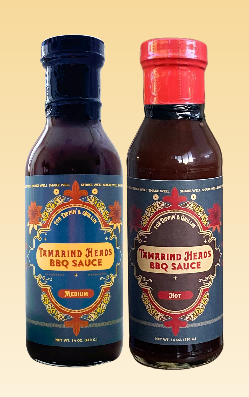
Tamarind Heads: Real Ingredients. Unreal Flavor. Superfood BBQ. 2024 Sofi Gold Award Winner for BBQ Sauce of the Year.

For the 242nd feature of our "Together Talks" campaign, we collaborated with Tamarind Heads and Co-Founder, Brittney Lim. Think of the best meal you’ve ever had.
It probably had that perfect balance of sweet, tang, and depth. That’s one of the powers of the tamarind superfruit—and we’ve finally made it accessible.
For too long, the condiment aisle has been a sea of the same: heavy corn syrup, artificial smoke, and predictable vinegars. We’re here to break the cycle. Tamarind Heads is a new category of flavor—a superfood-based, globally-inspired, joyful sauce that turns ordinary ingredients into award-winning dishes.
Real ingredients, unreal flavor. We don’t believe in fillers, and we definitely don’t believe in "boring." By using nutrient-dense tamarind pulp as our foundation, we’ve created a profile that is brighter, bolder, and more versatile than anything in your pantry. Tamarind is, after all, the flavor of the equator.
Whether it’s a glaze for cedar-plank salmon, a kick for your morning eggs, or the secret weapon in your stir-fry, Tamarind Heads is designed for people who live to eat.
What the buzz is about:
The "Gold" Standard: We didn’t just enter the room; we took the trophy. Our sauces are 2024/2025 sofi™ Gold Winners—voted the best in specialty food by the industry's toughest critics.
Clean Label, Zero Compromise: 100% plant-based, gluten-free, no preservatives, no crap. Just 6 ingredients & pure, vibrant flavor.
A Global Legacy: We’re bringing thousands of years of culinary heritage from across Tropical Africa, South Asia, and the Americas to the modern table.
Scale with Soul: From corner bodegas to national retailers, we are proving that "global-fusion" isn't a trend—it's the future of how we eat.
Don't just cook. Discover. We’re building a brand for the flavor-obsessed, the home-chef experimenters, and the retail partners who know that the "same old" isn't good enough anymore.
It’s time to find out why the world is finally turning to tamarind.
🌿 Superfood Based | 🏆 sofi™ Gold Winner | 📍 Veteran, Minority- & Women-Owned (MWBE)

"Together Talks" feature 242: Tamarind Heads presented by KLS - Your Trusted Shipping Solutions In The USA
What separates you from your competition? What have been the biggest challenges? Goals for upcoming year + Next phase of the company?
What have you learned since becoming an entrepreneur? What aspect of entrepreneurship do you appreciate the most? Share a decision that you made that was detrimental? What is your why?
Story of how it was created?
It really goes back to the fact that my husband and I have always been foodies. We come from completely different continents, but we both share a deep appreciation—and a soft spot—for tamarind.
His mom used to run a small farmer’s market stand where she sold a tamarind-based sauce, and we would see lines around the block for it.
That stuck with us.
We started experimenting with tamarind ourselves, playing around with what we could do with it. Around that time, we met our co-founder, Chef Jim, when Sashi was in business school.
He immediately recognized something special and encouraged us to keep going.
The three of us began working together, refining that original sauce and evolving it into what is now our award-winning barbecue sauce. From there, the rest is history.
What separates you from your competition?
For Tamarind Heads, barbecue is our category—and that’s exactly where we choose to compete. We are very intentional about positioning ourselves squarely within barbecue because we believe tamarind deserves to be a mainstream flavor.
Interestingly, tamarind is often the “secret ingredient” in many competition-winning barbecue sauces—especially in smaller regional circuits or high-level competitions. It’s usually just a subtle addition—a small but powerful touch.
We decided to take that idea and build an entire sauce around it.
Our biggest differentiator is that tamarind is the foundation of our product. It’s the first ingredient on our label—not water, not sugar, not corn syrup, which is the case for the vast majority of barbecue sauces on the market.
Tamarind is a superfood. It’s a global ingredient used across regions along the equator, and it brings a depth of flavor that is both unique and incredibly versatile.
While most barbecue sauces rely on tomato, vinegar, or mustard bases, we are the only brand building from a tamarind base.
We also think about our audience in three distinct groups.
First, there are barbecue purists—people who take their craft seriously and are very intentional about what they use. Many of them are already somewhat familiar with tamarind from competition circuits. For them, we position our sauce as a cleaner, more ingredient-forward option that elevates what they already know.
Second, there are consumers who come from regions where tamarind is already a staple—Mexico, Colombia, the Caribbean, South and Southeast Asia, parts of Africa, and the Middle East. For many of these customers, tamarind is deeply nostalgic. It’s something they grew up with.
Seeing that flavor represented in a mainstream grocery aisle—not relegated to a vague “international” section—is incredibly meaningful. For them, it’s about representation and recognition.
Third, there are consumers who may not immediately recognize tamarind but have likely experienced it before. Tamarind sits in that interesting space where people often say, “This tastes familiar,” even if they can’t quite place it.
For this group, we provide context. We explain that if they’ve had dishes like pad thai, Indian curries, or even higher-end barbecue sauces, they’ve likely already enjoyed tamarind.
From there, it becomes an invitation to explore, experiment, and have fun with cooking.
What have been the biggest challenges?
Like many CPG startups, one of our biggest challenges has simply been starting small while learning a complex industry.
Early on, we were fortunate to win a sofi™ Gold Award from the Specialty Food Association—essentially the Oscars of the food industry. Past winners include brands like Bachan’s, which was later acquired for hundreds of millions of dollars.
Winning that award brought a lot of attention very quickly.
The challenge then became balancing that momentum with the reality that we were still a small team, still learning retail, still understanding our customer.
There’s a real risk in growing too quickly without the infrastructure to support it—you can take that momentum and unintentionally drive it straight into a wall.
So for us, it’s been about pacing growth thoughtfully while climbing a steep learning curve.
That’s also why surrounding ourselves with strong mentors and founders who are a few steps ahead has been so important.

Goals for upcoming year + Next phase of the company?
We’re continuing to scale in retail. Currently, we’re in around 200 stores across roughly 20 states, and we’re seeing interest from additional retailers.
We recently added new doors in upstate New York, and our goal is to continue expanding—but with intention.
We’re focusing on deepening our presence along the East Coast and in regions where we already have traction, while continuing to learn more about our customers in each market.
In parallel, we’ve started to see traction in foodservice, which represents a major opportunity. Getting our product into restaurants, delis, and other foodservice environments helps introduce people to tamarind in a natural way.
That exposure builds familiarity, which in turn supports retail growth. Creating that synergy between foodservice and retail is a key focus for us.
Finally, we’re continuing to evolve our brand—investing more in our digital presence and preparing for an exciting brand refresh in the near future.
What were your concerns to transition to starting your own business?
At the beginning, this was something we were doing for fun. We weren’t initially thinking about it as a full-scale business—we were just exploring something we loved.
But over time, it started gaining traction.
For me personally, I didn’t necessarily see myself as a traditional entrepreneur. I appreciated the stability of a nine-to-five job, and at the time, I was also pregnant with our first child.
There were real questions around whether this was something we could take on given our life circumstances.
What ultimately pushed us forward was a combination of passion and validation. We believed deeply in the product, and the feedback we were receiving reinforced that belief.
We were also seeing broader signals—like tamarind being named Flavor of the Year by McCormick—and then winning the Sophie Gold Award ourselves.
At a certain point, it became clear: this was an opportunity we couldn’t ignore.
We made the decision to take the risk, and I still remember signing on the dotted line for our first retail chain while holding our newborn.
Since then, it’s been a continuous process of learning, balancing, and growing.
What have you learned since becoming an entrepreneur?
The honest answer is: everything.
We recently completed the Beyond CPG Accelerator, and it was a crash course in the fundamentals of this industry—everything from retail economics to velocity, margins, cost structures, and broker relationships.
My background was in education and intrapreneurship, not running a CPG company, so there has been a significant amount of tactical learning.
But beyond the technical skills, the biggest shift has been in mindset.
In a traditional job, you’re hired because of what you already know. In entrepreneurship, you step into a role where you don’t know everything—and you have to be okay with that.
You’re leading something while simultaneously learning how to lead it.
That requires a different level of self-awareness and self-compassion. It’s about trusting that your past experiences have equipped you with the ability to learn and adapt, even if you don’t have all the answers yet.
That mindset shift has been one of the most important parts of the journey.
What aspect of entrepreneurship do you appreciate the most?
I really enjoy the customer research side of the business—talking to people, hearing their feedback, and understanding how they experience the product.
I also love the vision-setting and strategic side—thinking about where tamarind can go and what we can build around it.
At the same time, I’ve developed a deep appreciation for the hands-on, tactical nature of the work.
Watching my co-founders—Sashi and Chef Jim—tackle complex challenges firsthand has been incredible. They’ve figured out how to process raw tamarind pods, which are notoriously difficult to work with, and essentially created a new production method here in the U.S.
We’ve built a “pod-to-bottle” process, rather than relying on paste or concentrates like most tamarind products.
That level of innovation—and the work behind it—is something I’m extremely proud of.
Share a decision that you made that was detrimental?
One of the more memorable mistakes was when my husband accidentally ordered an entire ton of organic brown sugar… to our New York City apartment building.
We had been juggling a lot at the time and simply overlooked the delivery address.
It was chaotic—but also a valuable lesson.
More broadly, it reinforced the importance of focus. In CPG, there are countless strategies and opinions—everyone is doing something slightly different, and it’s easy to get distracted.
We’ve had to learn how to stay focused on our own path, rather than chasing every new idea or trend.
Another major lesson came from our co-packer situation. We had been working with a co-manufacturer for years, and just as we secured a major retail opportunity, they informed us they were shutting down.
We had one month to produce inventory.
That experience highlighted the importance of always having backup options and being ready to move fast. You need to understand the broader landscape and have contingency plans in place.
Especially in CPG, timing is everything—and when opportunities come, you need to be ready.
What is your why?
There are a few layers to it.
On one level, there’s something deeply empowering about building something of your own—especially as a family.
This business is truly personal. My husband’s mother inspired the original recipe. My father has helped with demos. Chef Jim has been part of our lives for years.
It’s a real family effort, and that makes it incredibly meaningful.
On another level, it’s about the product itself.
We’ve created something genuinely innovative, and we’re bringing a flavor into the spotlight that has been overlooked for far too long.
Tamarind is a global ingredient—it connects cultures across continents. It’s used in so many different cuisines, and yet it hasn’t been fully embraced in the mainstream U.S. market.
We love being part of that bridge.
There’s something special about seeing people connect over it—realizing they’ve experienced it in different ways across cultures.
It creates a sense of shared discovery.

Do you have a moment that brings you the most joy?
One of the most meaningful moments for me was watching my co-founder—and husband—step into this business in a completely new way.
He was driving six hours each way, working hands-on with the machinery, solving problems in real time.
It was a level of grit and determination that I hadn’t seen before, even after being together for nearly 16 years.
That experience gave me a new sense of admiration and pride in him.
Of course, winning the Sofi Gold Award was also an incredible moment—but seeing that side of him was something deeply personal and unforgettable.
What is next?
We believe the real value of our company lies not just in our barbecue sauce, but in the tamarind base we’ve developed.
Because we operate on a true “pod-to-bottle” model, we retain more of the nutritional value and flavor of tamarind than traditional methods.
That base has the potential to extend far beyond barbecue.
We can apply it across multiple categories—condiments, marinades, even beverages. From tamarind ketchup to aioli to soda, the possibilities are wide-ranging.
We’re not going to pursue everything at once, but the platform we’ve built gives us a strong foundation for thoughtful expansion.
Piece of Advice
Keep going.
That’s the biggest lesson—and one that was shared with us by a mentor early on.
The difference between founders who succeed and those who don’t often comes down to persistence.
Things will go wrong. Plans will change. Unexpected challenges will arise.
But the founders who make it are the ones who find a way to keep moving forward—no matter what.
Promo Code
Purchase from their site, Tamarind Heads, and use promo code below.
TogetherTalksBBQ -> 20% off a 2-pack of our newest release: Spiced Honey BBQ!
Community Callout
I connected with her through the Startup CPG Slack community, and she has been an incredible resource for us.
She helped us avoid some early pitfalls—especially around scaling too quickly—and consistently offers clear, honest advice.
Having people like that in your corner makes a huge difference.
Our BeyondCPG mentors and network: Russel Kohn, Matt Merson, Eric Schnell, Gertrude Allen, Perri Gordon, George Roeth, Jeannie Cho, Carlotta Mast, Jared Simon, Raul Pero...the list goes on.
And our families. They've been on this journey with us, packing boxes of sauce, literally helping in the co-man facility, arms deep in tamarind processing, doing demos. They're the best.
In Closing
KLS wants to thank Tamarind Heads and Co-Founder, Brittney Lim, for today's "Together Talks" feature. Follow along for their journey with their social handles below!


Comments